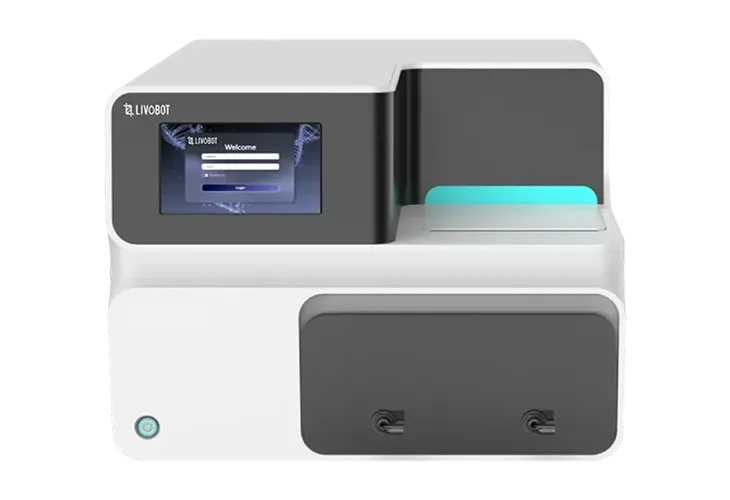
The LivoBot focused-ultrasonicator utilizes non-contact ACU™ (Adaptive Cylindrical Ultrasonic) focusing technology. This technology uses a custom-developed cylindrical ultrasonic transducer to geometrically focus high-frequency acoustic energy with a wavelength of approximately several millimeters onto the sample region, generating high-intensity acoustic energy pulses. By adjusting parameters such as peak power, pulse duration, and duty cycle, the acoustic energy is controlled to induce cavitation effects within the sample container. The oscillation and collapse of these cavitation bubbles produce acoustic microstreaming, which generates powerful hydrodynamic shear stress in the sample, thereby achieving sample fragmentation.
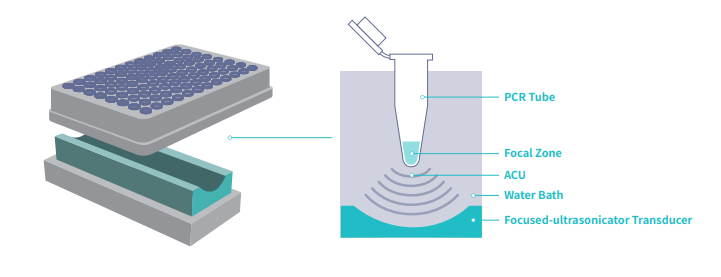
Conventional ultrasound fragmentation devices often suffer from issues such as difficult energy control and excessive heating, which compromise sample processing quality. The ACU™ technology of the EoSonics® FRAG series focused-ultrasonicator overcomes these limitations by focusing acoustic energy, utilizing a low-temperature coupling fluid environment, and enabling precise positional control. With extremely low energy input, it achieves accurate sample shearing while avoiding over-processing and thermal damage. This provides an efficient, controllable, and stable environment for sample processing, effectively preserving the biological activity of samples.
Leveraging an advanced acoustic control algorithm, the system precisely regulates key parameters of the acoustic pulses including peak power, pulse duration, interval period, and duty cycle to modulate the output acoustic energy. This enables it to meet the precise energy and processing time requirements of different sample types and experimental applications, supporting a wide range of processing needs from gentle extraction to efficient fragmentation. During sample processing, the system continuously monitors acoustic parameters and automatically adjusts the acoustic output through a feedback mechanism, ensuring process stability and consistency. Even when sample properties or experimental conditions vary, it consistently delivers high-quality results.

 CN
CN